Results and Test Cases
This section summarizes representative outputs from the implemented Diffie-Hellman system across live and numerical test scenarios.
Live Mode: Manual Example
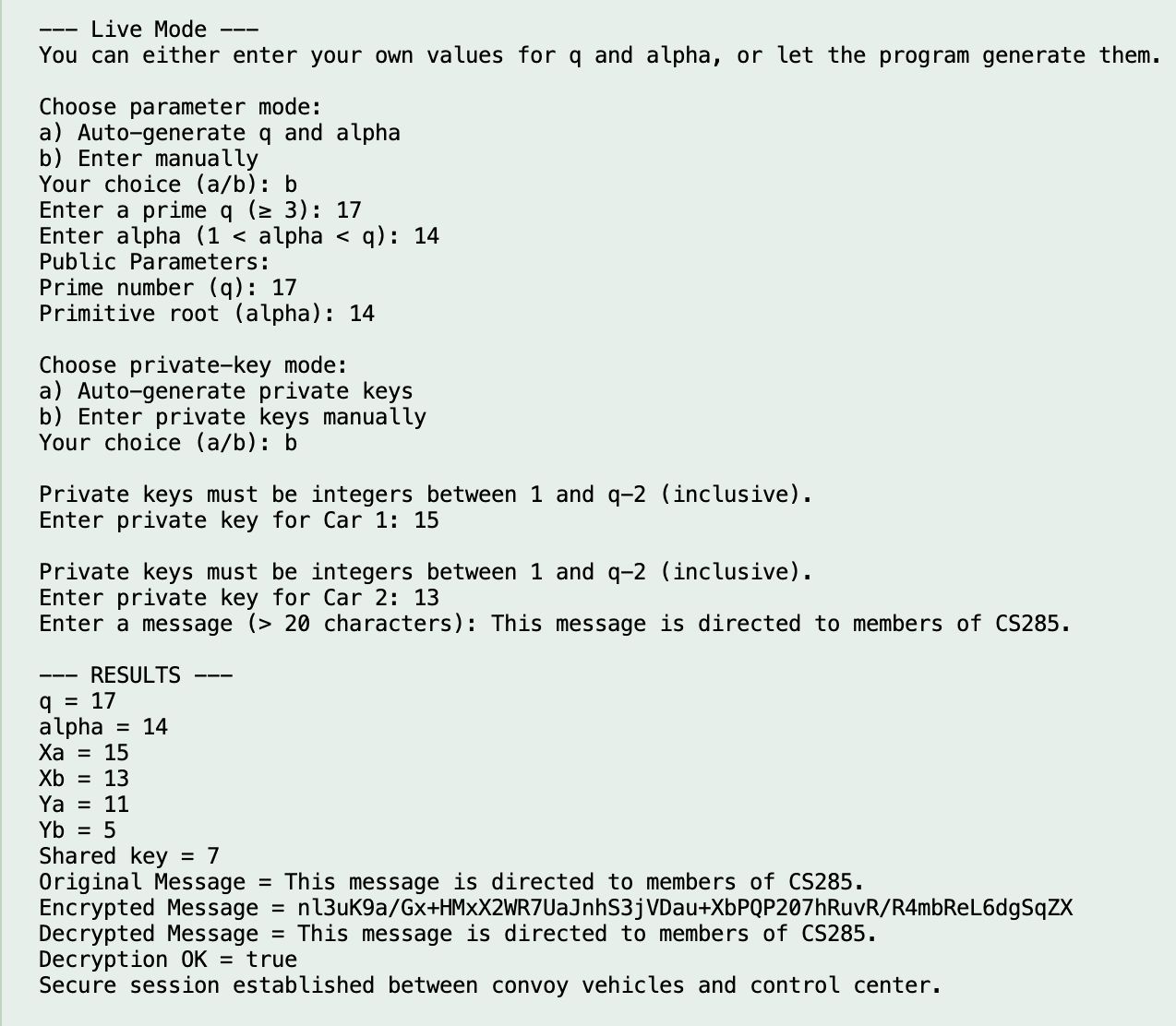
In manual live mode, users enter \( q \), \( \alpha \), and the message directly. The system validates each input before continuing.
After key generation and exchange, both participants derive the same shared key, then encrypt and decrypt the message successfully.
Observation
Matching decrypted output confirms successful shared-key derivation and correct message flow.
Live Mode: Invalid Alpha Input
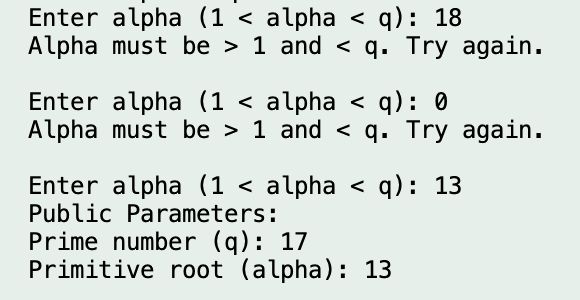
This case verifies input validation behavior. If a user provides \( \alpha \) outside the valid range \( 1 < \alpha < q \), the program rejects it and asks for a valid value.
Validation Path
Validator and Helpers jointly enforce numeric and range constraints before any cryptographic computation.
Numerical Example (Fixed Values)
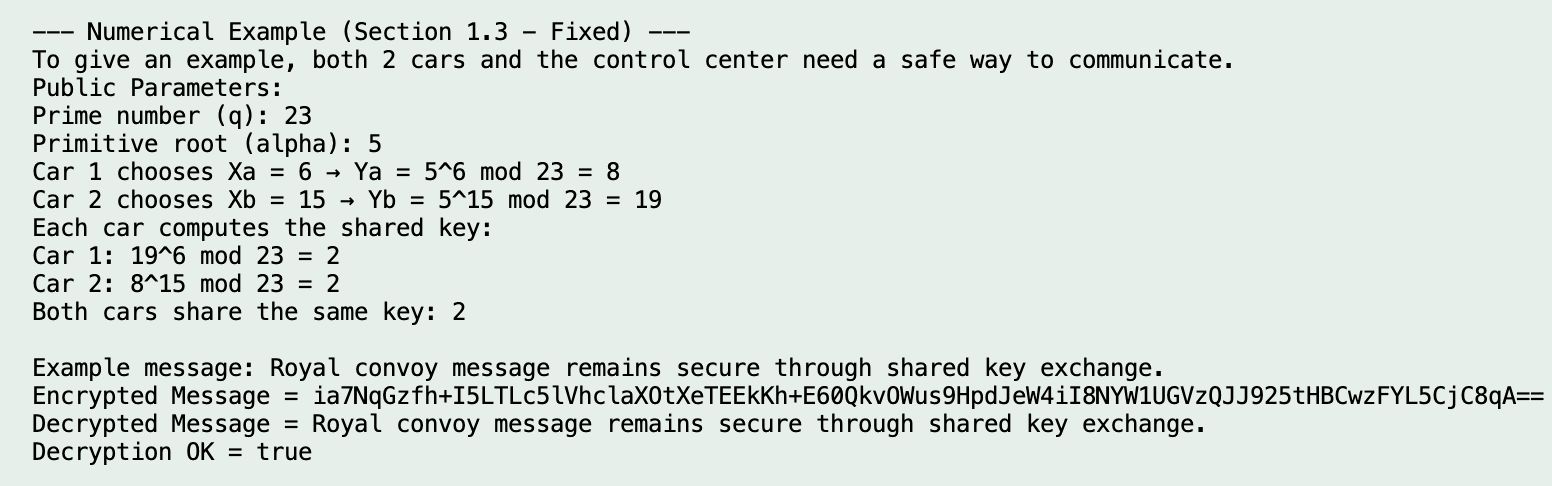
This test uses small values for transparent, step-by-step verification.
| Parameter | Value |
|---|---|
| Prime number (q) | 7 |
| Primitive root (alpha) | 6 |
| Private key \(X_a\) | 5 |
| Private key \(X_b\) | 3 |
| Shared key (K) | 1 |
Result Verification
Both participants compute the same shared key, validating implementation correctness.
DH vs ECDH Comparison
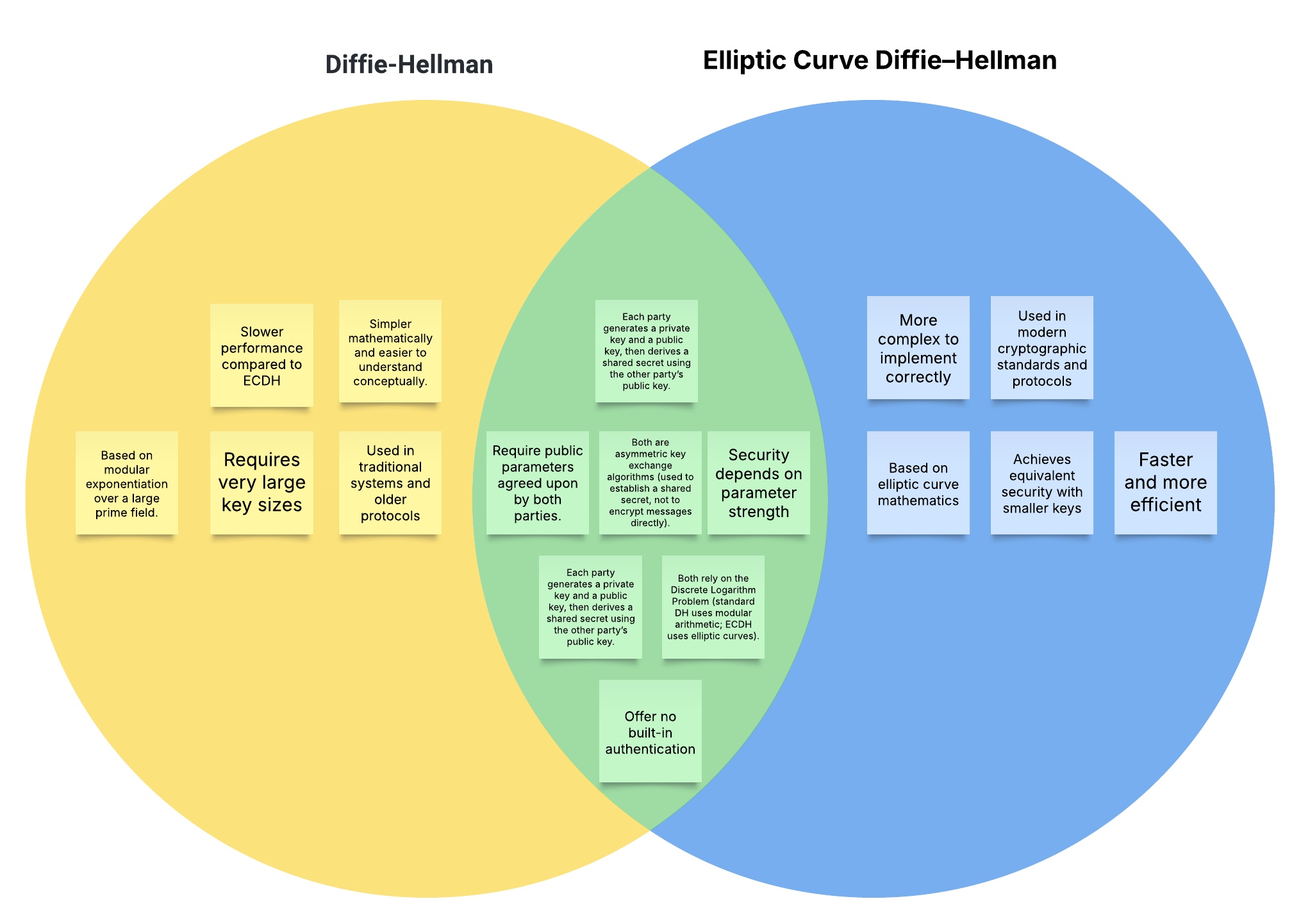
This visual comparison places the project in broader context.
Summary
DH and ECDH both establish shared secrets. ECDH typically provides comparable security with smaller keys and improved efficiency.